Epidemiological modeling of climate-dependent pathologies in northern Togo: Case of foot-and-mouth disease in the Savannah region
Authors
Essoninam PASSIKE POKONA, Pascal YAKA, Jacques André NDIONE
Key Information
Journal
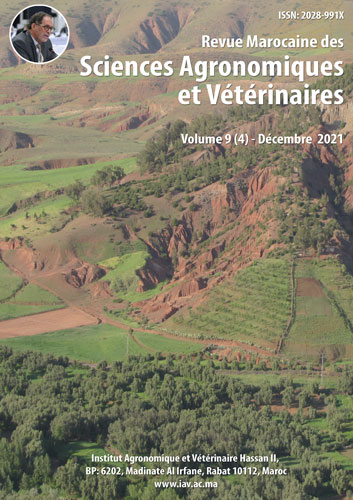
Published in Vol. 9 No. 4 (2021) of Moroccan Journal of Agricultural and Veterinary Sciences.
Multidisciplinary journal that publishes original research articles and literature reviews in the fields of agriculture, agronomy, rural engineering, topography, forestry, horticulture, food, nutrition, animal husbandry and veterinary science (online-ISSN: 2550-4401, print-ISSN: 2028-991X). Indexed by DOAJ, Google Scholar, Articles DOAJ, Mirabelle, ROAD, WorldCat
About the Journal
Abstract
If climate influences human health, there are many reasons to believe that, it also influences the epidemiology of Foot and Mouth Disease (FMD). Thus, the implementation of operational tools such as early warning models seems to be a great tool for the control of this disease, which considerably impactes livestock. Therefore, a study was conducted in the savanes region of Togo with climatological and epidemiological data for a period of nine (09) years (from 2009 to 2017). The methodology adopted consisted in generating a linear regression model on the basis of climatological parameters strongly correlated to the disease. The final model was set after dismissing less pertinent variables of the unrefined model by using the « Backward elimination ». Then, three (03) statistical tests (the variance inflation factor test, the Durbin-Watson test and the Goldfeld-Quandt test) were used for the model’s validation,before checking it robustness with Taylor diagram. Results showed that among climatological parameters strongly correlated with FMD, only precipitation and sunshine duration were found to be the most pertinent variable of the model. It has shown to be relatively good predictive accuracy by reproducing quite well, the seasonality of the disease (beginning, peak and end). It also has a relatively high correlation coefficient (r) of 75% with a normalized standard deviation of 1.05 very close to the reference (1). Appliances should be taken during the rainy seasons and festives months because these periods are propitious to the development and spreading of FMD.
Keywords : Epidemiological model, climatological parameters, Foot and Mouth Disease (FMD), Savanes Region, Togo.
References
Details
License

Revue Marocaine des Sciences Agronomiques et Vétérinaires est mis à disposition selon les termes de la licence Creative Commons Attribution - Pas d’Utilisation Commerciale - Partage dans les Mêmes Conditions 4.0 International.
Fondé(e) sur une œuvre à www.agrimaroc.org.
Les autorisations au-delà du champ de cette licence peuvent être obtenues à www.agrimaroc.org.