Protection of dry fish stocks in sub-Saharan Africa
Authors
B. R. TAMGNO, J. VATSOU, GOMA ZIDIKO, A. GOUDOUM, L. S. NGAMO TINKEU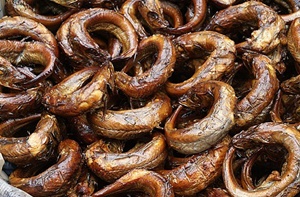
Key Information
Journal
Published in Vol. 9 No. 4 (2021) of Moroccan Journal of Agricultural and Veterinary Sciences.
Multidisciplinary journal that publishes original research articles and literature reviews in the fields of agriculture, agronomy, rural engineering, topography, forestry, horticulture, food, nutrition, animal husbandry and veterinary science (online-ISSN: 2550-4401, print-ISSN: 2028-991X). Indexed by DOAJ, Google Scholar, Articles DOAJ, Mirabelle, ROAD, WorldCat
About the Journal
Abstract
An effective solution to malnutrition in sub-Saharan Africa is the promotion and increasing consumption of fish. This very rich food is a very highly perishable commodity, which the local fisherman loses if no processing measures are taken. A fairly rare and old bibliography shows that é& species of fish caught in the northern regions of Cameroon undergo an artisanal transformation in order to extend the shelf life and preserve its quality and food potential. Unfortunately, despite these approaches, many loss factors such as insect pests, mites and fungi, rotting agents, cause significant losses to dry fish during storage. Dry fish comes from an artisanal drying and smoking process. To avoid these losses, the fish during processing and storage is treated with chemical formulations from 22 active ingredients, some of which are extremely dangerous. An alternative to these dangerous pesticides is to include in the processing ingredients of fish, spice plants of which 14 locally available have proven insecticidal, fungicidal or acaricidal properties. With a view to developing tools to protect dry fish stocks by limiting consumer intoxication and environmental pollution, there is an urgent need for more detailed studies to be carried out with the aim of developing energy-efficient transformation processes, which incorporate natural insecticides as alternatives limiting natural or industrial contamination and providing a healthy and safe food.
Keywords: Dry fish, Loss factors, Pesticides, Storage, Alternatives
References
Details
License

Revue Marocaine des Sciences Agronomiques et Vétérinaires est mis à disposition selon les termes de la licence Creative Commons Attribution - Pas d’Utilisation Commerciale - Partage dans les Mêmes Conditions 4.0 International.
Fondé(e) sur une œuvre à www.agrimaroc.org.
Les autorisations au-delà du champ de cette licence peuvent être obtenues à www.agrimaroc.org.