Practice of traditional slash-and-burn agriculture in the commune of Molegbe (Gbado-Lite, Nord-Ubangi) in Democratic Republic of the Congo
Authors
N.M. KPULA, J-P. KOTO-TE-NYIWA NGBOLUA, R.L. ASSI, A.G NZAMONGA, P.L. ANDIA, C.A. MASENGO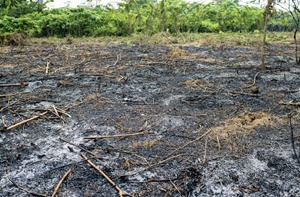
Key Information
Journal
Published in Vol. 9 No. 4 (2021) of Moroccan Journal of Agricultural and Veterinary Sciences.
Multidisciplinary journal that publishes original research articles and literature reviews in the fields of agriculture, agronomy, rural engineering, topography, forestry, horticulture, food, nutrition, animal husbandry and veterinary science (online-ISSN: 2550-4401, print-ISSN: 2028-991X). Indexed by DOAJ, Google Scholar, Articles DOAJ, Mirabelle, ROAD, WorldCat
About the Journal
Abstract
The purpose of this study was to investigate the practice of traditional agriculture among 200 respondents (136 men and 64 women) using the stratified probability sampling method. The study revealed that agriculture is the main activity of the respondents (100%) followed by NTFP harvesting (98%), hunting (78%) and animal husbandry (12%) respectively. The respondents clear their fields in the forest, which are located 11-20 km from the place of residence. The duration of exploitation of agricultural land is one year for 78.5% of respondents. For 46% of respondents, the age of fallow land is usually between 5 and 10 years. During the one-year cropping cycle, 39.5% of farmers cleared at least 1 hectare of forest, while 25.5% of respondents cleared more than 1 hectare of primary forest each, while 35% each cleared less than 1 hectare. The forest area cleared during the annual cropping cycle is estimated at 245 ha or 0.006%, this can lead to a loss of primary forest cover of at least 0.15% in 25 years if nothing is done now. The results of this survey thus show that slash-and-burn agriculture is a real threat to the Nord-Ubangi forest massif. For this reason, it is desirable that work be undertaken to raise public awareness of sustainable agriculture and that this be followed by the elaboration of a forest management plan for the conservation of biodiversity.
Keywords: Agriculture, primary forest, biodiversity, degradation, habitat, fragmentation
References
Details
License

Revue Marocaine des Sciences Agronomiques et Vétérinaires est mis à disposition selon les termes de la licence Creative Commons Attribution - Pas d’Utilisation Commerciale - Partage dans les Mêmes Conditions 4.0 International.
Fondé(e) sur une œuvre à www.agrimaroc.org.
Les autorisations au-delà du champ de cette licence peuvent être obtenues à www.agrimaroc.org.