Phytosanitary practices of apple growers: Case of the Fès-Meknes region
Authors
Rachid LAHLALI, Mohammed BOULIF, Alieu MOININA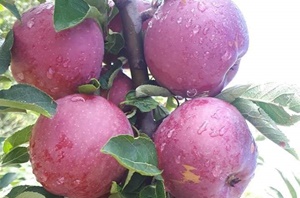
Key Information
Journal
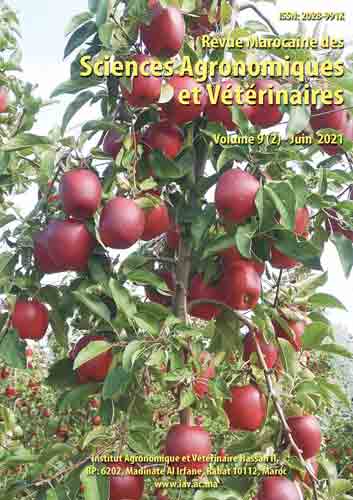
Published in Vol. 9 No. 2 (2021) of Moroccan Journal of Agricultural and Veterinary Sciences.
Multidisciplinary journal that publishes original research articles and literature reviews in the fields of agriculture, agronomy, rural engineering, topography, forestry, horticulture, food, nutrition, animal husbandry and veterinary science (online-ISSN: 2550-4401, print-ISSN: 2028-991X). Indexed by DOAJ, Google Scholar, Articles DOAJ, Mirabelle, ROAD, WorldCat
About the Journal
Abstract
In the region of Fès-Meknes, especially in the Middle Atlas, apple tree cultivation is of paramount importance. Indeed, it ranks second among tree crops in the region behind the almond. Nevertheless, this crop is prone to a multitude of diseases, pests and weed infestation. A survey on the knowledge, perceptions and practices (KPP) of apple growers in the fight against apple pests and climate change was carried out in spring 2018 in two main apple-producing provinces in the Fez-Meknes region. Each apple grower said they saw an average of two diseases and three pests in their orchards. Phytosanitary protection was achieved by a combination of cultural and chemical control methods. All apple growers surveyed applied winter treatments and about 60% of them adopted pest monitoring by visual inspection before applying phytosanitary products. In addition, 42% of respondents chose the latter on the basis of information received from pesticide dealers and an average of 20 treatments per year was applied in each orchard. Multiple regression analysis showed that neither the age of the apple trees nor the number of pesticide applications affected yield. As for the adverse weather conditions, all apple orchards were affected and the problems frequently experienced were frost, hail, hot wind and water scarcity. 51% of orchards were protected with anti-hail nets. In order to reduce the rate of pesticide applications, organic farming is an alternative approach and around 40% have agreed to convert to this practice provided that market facilitation is established.
Keywords: Apple orchards, apple growers' CPP, phytosanitary protection, climate change, Fès-Meknes region, Morocco
References
Details
License

Revue Marocaine des Sciences Agronomiques et Vétérinaires est mis à disposition selon les termes de la licence Creative Commons Attribution - Pas d’Utilisation Commerciale - Partage dans les Mêmes Conditions 4.0 International.
Fondé(e) sur une œuvre à www.agrimaroc.org.
Les autorisations au-delà du champ de cette licence peuvent être obtenues à www.agrimaroc.org.