Epidemiology of black Sigatoka of banana (Musa spp.) in ecological zone IV of Togo
Authors
Bawoumodom Pyabalo I Tchaou BODJONA, Komi ODAH, Kossi Essotina KPEMOUA, Rassimwaï PITEKELABOU, Atalaèsso BOKOBANA, Koffi Apeti GBOGBO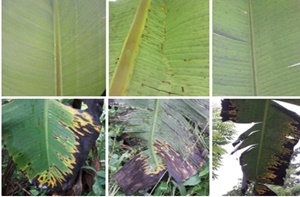
Key Information
Journal
Published in Vol. 9 No. 1 (2021) of Moroccan Journal of Agricultural and Veterinary Sciences.
Multidisciplinary journal that publishes original research articles and literature reviews in the fields of agriculture, agronomy, rural engineering, topography, forestry, horticulture, food, nutrition, animal husbandry and veterinary science (online-ISSN: 2550-4401, print-ISSN: 2028-991X). Indexed by DOAJ, Google Scholar, Articles DOAJ, Mirabelle, ROAD, WorldCat
About the Journal
Abstract
Bananas are the most consumed fruit in the world and in West Africa. However, banana plantations are often attacked by an ascomycete fungus called Mycosphaerella fijiensis M., responsible for black leaf streak disease (BLSD) or black Sigatoka with yield losses greater than 50%. The objective of this study is to identify varieties of bananas that are resistant, tolerant or susceptible to BLSD. This study was carried out in fifteen (15) plantations of bananas and plantains in ecological zone IV of Togo. The results showed that the disease incidence (IM) varies from 91.0 ± 21.6 to 100.0% ± 0.00 in the fields and the severity index (IS) varies from 94.0% ± 23.5 for the Dankodu variety to 145.0% ± 96.4 for the Agbavé variety, which indicates that all varieties found in this zone would be very sensitive. Our selection work in the greenhouse will allow us to identify the susceptible varieties and to consider ways of stimulating the natural defense of these varieties by inoculation with an elicitor.
Keywords: banana, black Sigatoka, incidence, Togo
References
Details
License

Revue Marocaine des Sciences Agronomiques et Vétérinaires est mis à disposition selon les termes de la licence Creative Commons Attribution - Pas d’Utilisation Commerciale - Partage dans les Mêmes Conditions 4.0 International.
Fondé(e) sur une œuvre à www.agrimaroc.org.
Les autorisations au-delà du champ de cette licence peuvent être obtenues à www.agrimaroc.org.