Quality of aquifers in the Aïn el Atti region (immediate upstream of the Tafilalet plain)
Authors
Mohamed AOUBOUAZZA, Houria DAKKAK, Abdelmjid ZOUAHRI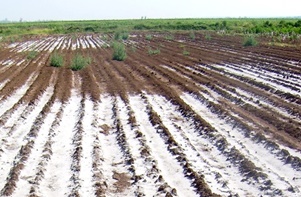
Key Information
Journal
Published in Vol. 9 No. 1 (2021) of Moroccan Journal of Agricultural and Veterinary Sciences.
Multidisciplinary journal that publishes original research articles and literature reviews in the fields of agriculture, agronomy, rural engineering, topography, forestry, horticulture, food, nutrition, animal husbandry and veterinary science (online-ISSN: 2550-4401, print-ISSN: 2028-991X). Indexed by DOAJ, Google Scholar, Articles DOAJ, Mirabelle, ROAD, WorldCat
About the Journal
Abstract
The present results were obtained with the project IAEA-TC (INT/5/144) on the sustainable utilisation of the saline groundwater and saline lands for plant production in the Aïn el Atti region, Tafilalet plain (Morocco). This region lies within the Saharan climate with less than 90 mm as average annual rainfall. This site is characterized by the existence of a multilayer aquifer’s systems: the Infracenomanian, the Turonian, the Senonian and the Quaternary. In this region, a network of 20 water points were set up for the physico-chemical analysis (pH, Temperature, Electrical conductivity) to monitor salinity evolution of the groundwater, identify its origin and estimate the groundwater recharge. Water samples were taken once every three months from the Ziz River, the Quaternary, the Senonian, the Turonian and the Infracenomanian groundwater. Overall, we distinguished between three facies types: (i) Sodium-Chloride for the artesian wells, the Quaternary aquifer and the Ziz river, (ii) Calcium-Sulfate for the Turonian aquifer with the evolution towards Calcium-Chloride and (iii) Calcium-Bicarbonate for the Senonian aquifer. According to the US Salinity Laboratory Staff classification (1954), the dominant class is C5S3-4. However, the high salinity and sodicity of these groundwater does not cause neither reduction of permeability and nor surface soil salt accumulation.
Keywords: Salinity, sodicity, aquifer, Tafilalet, Morocco
References
Details
License

Revue Marocaine des Sciences Agronomiques et Vétérinaires est mis à disposition selon les termes de la licence Creative Commons Attribution - Pas d’Utilisation Commerciale - Partage dans les Mêmes Conditions 4.0 International.
Fondé(e) sur une œuvre à www.agrimaroc.org.
Les autorisations au-delà du champ de cette licence peuvent être obtenues à www.agrimaroc.org.