Floristic and ecological characteristics of the plant formations of Gouré (South-eastern Niger)
Authors
Maman Kamal ABDOU HABOU, Habou RABIOU, Saley KARIM, Rahila MAAZOU, Issiaka ISSAHAROU MATCHI, Ali MAHAMANE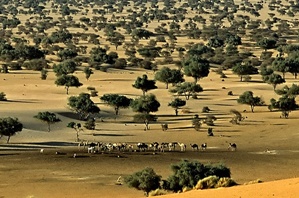
Key Information
Journal
Published in Vol. 8 No. 2 (2020) of Moroccan Journal of Agricultural and Veterinary Sciences.
Multidisciplinary journal that publishes original research articles and literature reviews in the fields of agriculture, agronomy, rural engineering, topography, forestry, horticulture, food, nutrition, animal husbandry and veterinary science (online-ISSN: 2550-4401, print-ISSN: 2028-991X). Indexed by DOAJ, Google Scholar, Articles DOAJ, Mirabelle, ROAD, WorldCat
About the Journal
Abstract
The present study aims to evaluate the characteristics of the vegetation of the department of Gouré. The data were collected using phytosociological surveys and dendrometric measurements in plots of 1000 m2 located in different units of land use (basins, dunes and shallows). A total of 56 surveys were conducted. The carried out phytosociological inventories showed the floristic richness with 81 species distributed in 68 genera and 29 families. A matrix made up of 81 species and 56 surveys, submitted to a Detrended Correspondence Analysis (DCA) and the Ascending Hierarchy Classification (CHA) discriminated three plant communities. It is about plant communities of Hyphaene thebaica and Amaranthus spinosus (G1); Acacia raddiana and Cenchrus biflorus (G2) and the grouping Leptadenia pyrotechnica and Aristida mutabilis (G3). In addition, therophytes followed by microphanerophytes are the dominant biological types. The Sudano-Zambezian and Guineo-Congolese-Sudano-Zambezian species are the dominant phytogeographic types. The Shannon diversity index varied from 3.13 to 5.16 bits and the Pielou equitability from 0.56 to 0,86. The diameter structure of woody stands shows that individuals of the Acacia raddiana and Cenchrus biflorus (G2) and Leptadenia pyrotechnica and Aristida mutabilis (G3) groups are dominated by small diameter individuals whereas the grouping with Hyphaene thebaica and Amaranthus spinosus (G1) are dominated by large subjects.
Keywords: Floristic diversity, biological and phytogeographic types, plant communities, demographic structure, Gouré
References
Details
License

Revue Marocaine des Sciences Agronomiques et Vétérinaires est mis à disposition selon les termes de la licence Creative Commons Attribution - Pas d’Utilisation Commerciale - Partage dans les Mêmes Conditions 4.0 International.
Fondé(e) sur une œuvre à www.agrimaroc.org.
Les autorisations au-delà du champ de cette licence peuvent être obtenues à www.agrimaroc.org.