Effectiveness of bioengineering techniques for water erosion control of slopes of the Fez-Taza Highway (Morocco)
Authors
Aicha MOUISAT, Chérif HARROUNI, Chaouki AL FAIZ, Ahmed DOUAIK, Abdelkrim DERRADJI, Nour-Eddine BENAODA TLEMCANI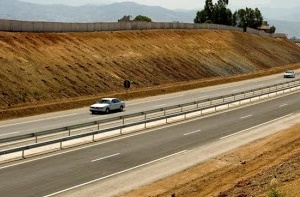
Key Information
Journal
Published in Vol. 8 No. 1 (2020) of Moroccan Journal of Agricultural and Veterinary Sciences.
Multidisciplinary journal that publishes original research articles and literature reviews in the fields of agriculture, agronomy, rural engineering, topography, forestry, horticulture, food, nutrition, animal husbandry and veterinary science (online-ISSN: 2550-4401, print-ISSN: 2028-991X). Indexed by DOAJ, Google Scholar, Articles DOAJ, Mirabelle, ROAD, WorldCat
About the Journal
Abstract
Mountainous topography, intense rainfall events and marly soils are constraints that have made slopes of the Fez-Taza highway highly exposed to water erosion. As a matter of fact, soon after their construction, these slopes were subjected to various forms of erosion with varying severities depending on rain intensity. Since mechanical stabilization proved to be too costly or ineffective for some slopes, the authors evaluated the effectiveness of some low-cost techniques based on bioengineering. These techniques are sowing and planting with mesh bamboo, sowing with straw and wire mesh and just sowing. The experiment was conducted by installing linear containers (4 m) in the bottom of plots (4×18 m2; 4×28 m2) of bioengineering treatments, in north and south facing slopes. These bioengineering treatments led to a 65% reduction, compared to control plots, in erosion with the use of sowing, 74% with the use of sowing and planting with mesh bamboo, and 78% with the use of sowing with straw and wire mesh. The highest erosion sediments were from the control plots with 12.7 kg as a maximum of dry quantity of eroded soil for 33 mm of rain with an intensity of 58 mm/h for one plot. The vegetation cover is more important on the northern slopes. It is therefore necessary to choose adapted species that consume less water for southern slopes.
Keywords: Erosion, marls, bioengineering, sowing, planting, highway.
References
Details
License

Revue Marocaine des Sciences Agronomiques et Vétérinaires est mis à disposition selon les termes de la licence Creative Commons Attribution - Pas d’Utilisation Commerciale - Partage dans les Mêmes Conditions 4.0 International.
Fondé(e) sur une œuvre à www.agrimaroc.org.
Les autorisations au-delà du champ de cette licence peuvent être obtenues à www.agrimaroc.org.