Regulation of public-private partnership in irrigation: Case of El Guerdane project in the Souss-Massa area
Authors
Nassreddine MAATALA, Mohammed Taoufiq CHATI, Majid BENABDELLAH, Philippe LEBAILLY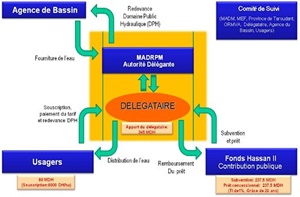
Key Information
Journal
Published in Vol. 7 No. 1 (2019) of Moroccan Journal of Agricultural and Veterinary Sciences.
Multidisciplinary journal that publishes original research articles and literature reviews in the fields of agriculture, agronomy, rural engineering, topography, forestry, horticulture, food, nutrition, animal husbandry and veterinary science (online-ISSN: 2550-4401, print-ISSN: 2028-991X). Indexed by DOAJ, Google Scholar, Articles DOAJ, Mirabelle, ROAD, WorldCat
About the Journal
Abstract
The use of public-private partnership in the field of irrigation by Morocco was initiated in 2005 within the framework of the El Guerdane project whose objective is to safeguard a citrus area of 10,000 ha. The purpose of this research is to describe the role of the Department of Agriculture as delegating authority and the organization of the service responsible for monitoring and regulation of public-private partnership projects, the various risks associated with this partnership project and its various performance indicators. Also, a comparison between the El Guerdane and Issen perimeters in terms of regulation was carried out. The methodology followed was based on interviews with the various stakeholders of the project. This analysis shows that the project has developed effective means to control, monitor and regulate the project upstream and downstream. Indeed, it has set up at the level of the delegating authority a service exclusively dedicated to this control and downstream of a commission that meets annually or sit representatives of beneficiaries. In terms of governance performance, the private partner has assumed part of the investment and operating risks to ensure the sustainability of the irrigation tool. Also, the quality of the water service has been improved, the availability of water resources has become better and is based on demand, and the cost of the service of irrigation water is borne by the users. Which made it possible to avoid transfers from the state budget (annual subsidies) for additional maintenance or the need for rehabilitation. However, the delegation of a water service should not be limited to the setting up of a commercial and contractual irrigation water distribution system, but rather establish a system of advice to provide farmers with the necessary services. Technical messages to better manage irrigation water and their production system to meet the requirements of this new management method.
Keywords: Public-Private Partnership, irrigation, regulation
References
Details
License

Revue Marocaine des Sciences Agronomiques et Vétérinaires est mis à disposition selon les termes de la licence Creative Commons Attribution - Pas d’Utilisation Commerciale - Partage dans les Mêmes Conditions 4.0 International.
Fondé(e) sur une œuvre à www.agrimaroc.org.
Les autorisations au-delà du champ de cette licence peuvent être obtenues à www.agrimaroc.org.