Ethnobotanical and floristic study of some medicinal plant species sold in Kinshasa city, Democratic Republic of Congo
Authors
Koto-te-Nyiwa NGBOLUA, Clément L. INKOTO, Nicole L. MONGO, Colette Masengo ASHANDE, Y.B. Da-Musa MASENS, Pius T. MPIANA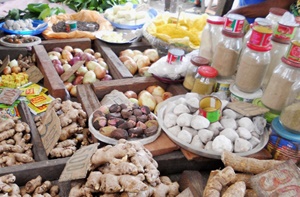
Key Information
Journal
Published in Vol. 7 No. 1 (2019) of Moroccan Journal of Agricultural and Veterinary Sciences.
Multidisciplinary journal that publishes original research articles and literature reviews in the fields of agriculture, agronomy, rural engineering, topography, forestry, horticulture, food, nutrition, animal husbandry and veterinary science (online-ISSN: 2550-4401, print-ISSN: 2028-991X). Indexed by DOAJ, Google Scholar, Articles DOAJ, Mirabelle, ROAD, WorldCat
About the Journal
Abstract
According to the WHO, more than 80% of the population in Africa resort to traditional medicine to solve primary health problem. In the present study, an ethnobotanical survey was carried out according to a stratified probabilistic sampling plan in five markets of the district of Mont-Amba, in Kinshasa city. The ethnobotanical data collected were then supplemented by information concerning plant ecological types. 47 species belonging 44 genera and 29 families were inventoried in the medicinal flora of the District of Mont-Amba. These plant species are used in treating 41 diseases but only the treatment of poison (toxicological hepatitis), sexual weakness, malaria and tooth decay received an informant consensus factor ? 50%. According to the value of agreement use, only the following eight plant species are of interest: Aframomum melegueta, Garcinia kola, Gladiolus gregarius, Gongronema latifolium, Heinsia crinita, Morinda morindoides, Quassia africana and Sarcocephalus latifolius. It is thus desirable that studies should be carried out on these eight plant species in order to collect scientific data for guiding future research on the phytochemistry and the bioactivity which will lead to the domestication of raw materials for the development of improved plant-based medicines. Also, the creation of a botanical garden of medicinal plants will be able to contribute to the safeguard of the medically active plants, the diffusion of knowledge, medical and pharmaceutical experiences and sociocultural exchanges.
Keywords: Ethno-botanical survey, medicinal plant species, sustainable management, conservation, Democratic Republic of the Congo
References
Details
License

Revue Marocaine des Sciences Agronomiques et Vétérinaires est mis à disposition selon les termes de la licence Creative Commons Attribution - Pas d’Utilisation Commerciale - Partage dans les Mêmes Conditions 4.0 International.
Fondé(e) sur une œuvre à www.agrimaroc.org.
Les autorisations au-delà du champ de cette licence peuvent être obtenues à www.agrimaroc.org.