Evaluation of vertisol compaction by horizontal and vertical penetrometry methods
Authors
Yassine AL MASMOUDI, Abdellah EL AISSAOUI, Oussama El GHARRAS, Khalid IBNO NAMR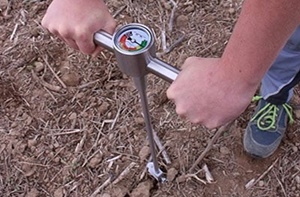
Key Information
Journal
Published in Vol. 6 No. 1 (2018) of Moroccan Journal of Agricultural and Veterinary Sciences.
Multidisciplinary journal that publishes original research articles and literature reviews in the fields of agriculture, agronomy, rural engineering, topography, forestry, horticulture, food, nutrition, animal husbandry and veterinary science (online-ISSN: 2550-4401, print-ISSN: 2028-991X). Indexed by DOAJ, Google Scholar, Articles DOAJ, Mirabelle, ROAD, WorldCat
About the Journal
Abstract
Modern agriculture is pushing to intensively use heavy agricultural machinery. The traffic of those machines can lead to soil compaction and considerably influence soil physical properties such as bulk density and porosity and thus limiting storage of water and soil aeration. As a result, root development and plant growth are impeded. In order to evaluate compaction in a vertisol, a horizontal measurement tool was developed and compared with a vertical cone penetrometer. The measuring tool is based on a chassis equipped with furrow opener and hydraulic cylinder coupled to a hydraulic pressure sensor (Bosch®, P max = 1500 Bars). The penetrometer (V cone) was also connected to an equivalent hydraulic pressure sensor to evaluate the vertical penetration force. The results obtained from the horizontal method showed compaction zones measured by voltage variations from different points of the experimental site. The voltage variations obtained in the middle (473.5 - 630.8 mV) and in the extremities (480 mV-700 mV) of the site are relative, respectively, to the penetration forces (0.002 - 4.60 MPa) and (0.002 - 7,27 MPa). Also, the vertical method allowed the detection of 694 mV (7.04 MPa) and 935 mV (16.33 MPa) measurements respectively in the middle and in the extremities of the site. The results obtained showed that there was a problem of soil compaction in the studied site and that physico-chemical aspects and soil management can indicate reasons for the vulnerability of vertisol to compaction and help to optimize soil management.
Keywords: Vertisol, Compaction, Vulnerability, Horizontal penetrometer, Vertical penetrometer.
References
Details
License

Revue Marocaine des Sciences Agronomiques et Vétérinaires est mis à disposition selon les termes de la licence Creative Commons Attribution - Pas d’Utilisation Commerciale - Partage dans les Mêmes Conditions 4.0 International.
Fondé(e) sur une œuvre à www.agrimaroc.org.
Les autorisations au-delà du champ de cette licence peuvent être obtenues à www.agrimaroc.org.