Influence of hydrodynamic properties of soil on the susceptibility to cedar decline in the Central Moroccan Middle-Atlas Causse
Authors
Mohamed AOUBOUAZZA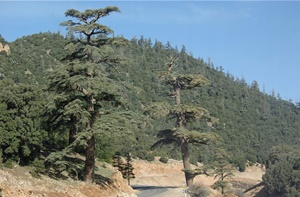
Key Information
Journal
Published in Vol. 5 No. 3 (2017) of Moroccan Journal of Agricultural and Veterinary Sciences.
Multidisciplinary journal that publishes original research articles and literature reviews in the fields of agriculture, agronomy, rural engineering, topography, forestry, horticulture, food, nutrition, animal husbandry and veterinary science (online-ISSN: 2550-4401, print-ISSN: 2028-991X). Indexed by DOAJ, Google Scholar, Articles DOAJ, Mirabelle, ROAD, WorldCat
About the Journal
Abstract
In Morocco, the cedar forest knows dieback problem sometimes generalized in some areas because of the increasing water deficit that prevails there year after year. To approach this question, the study was based on a small sample of 15 representative plots of 54 soil profiles. Twelve of them belonging to the Azrou forest where dieback is low, and the other three to the Aït Youssi forest of Amekla, with a high cedar dieback, have been subjected to monitoring and analysis of their physical properties and hydrodynamics. In the studied parameters, permeability was the most decisive soil property on dieback of the cedar, as it contributes to significantly to soil water balance. Permeability is high in brown sandy deep soils on calcarious substrate or alluvial soils forming excellent reservoirs where the cedar dieback rate is low (5 -15 %). It decreases sharply through in loamy-clay fersiallitic soil with less cracks, where the cedar dieback rate is high (20-50 %). Permeability is very low in superficial compact hydromorphic daya soil, where no cedar forest is reported. In these topographic depressions, the thick clay is characterized by waterproof hydraulic barriers. In this study, we highlight a significant and positive correlation between the dieback rate of the cedar and clay content of soil. Clay reduces infiltration and generates runoff, which increases the water deficit.
Key words: Dieback, cedar, water deficit, soil permeability, soil, Morocco.
References
Details
License

Revue Marocaine des Sciences Agronomiques et Vétérinaires est mis à disposition selon les termes de la licence Creative Commons Attribution - Pas d’Utilisation Commerciale - Partage dans les Mêmes Conditions 4.0 International.
Fondé(e) sur une œuvre à www.agrimaroc.org.
Les autorisations au-delà du champ de cette licence peuvent être obtenues à www.agrimaroc.org.