Inventory of fungi associated with symptoms of cashew gummosis in Burkina Faso
Published 2025-07-11
Keywords
- Array,
- Array,
- Array,
- Array,
- Array
- Array ...More
Copyright (c) 2025 Moroccan Journal of Agricultural and Veterinary Sciences

This work is licensed under a Creative Commons Attribution-NonCommercial-ShareAlike 4.0 International License.
Abstract
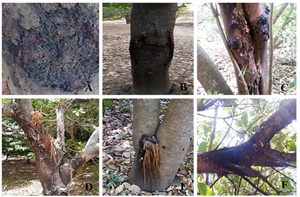
This study aimed to evaluate the incidence and severity of cashew gummosis, describe the symptoms and inventory the associated fungal pathogens. Seven provinces were surveyed, namely Houet, Kénédougou, Léraba, Comoé, Poni, Noumbiel and Sissili in cashew orchards hosting “elite candidate” trees. The results revealed that the symptoms of cashew gummosis included dark cankers on the trunk and branches, anormal gum exudation at the cankers sites, twig wilting, leaf drop, dieback, and in some cases complete death of the tree. Highly significant differences were observed in both the incidence and severity of the disease. The incidence ranged from 63.8% to 100%, while severity varied 19.9% to 46.1%. A total of eight fungal species were isolated. The most frequent was Lasiodiplodia spp (51%), followed by Pestalotia spp and Fusarium spp (13%), Aspergillus niger (10%), Colletotrichum gloeosporioides (6%), Penicillium sp (5%), Curvularia lunata (2%) and Botrytis cinerea (2%). The results reveal the severity of cashew gummosis in Burkina Faso and the diversity of associated fungal pathogens. Molecular characterization combined with pathogenicity tests would allow identify the specific causal agent (s), in order to develop effective disease control strategies.
Keywords: Anacardium occidentale, fungi, incidence, severity, province, Burkina Faso