Yields of traditional Acacia auriculiformis and A. mangium charcoal kilns on the Batéké Plateau, DR Congo

Abstract
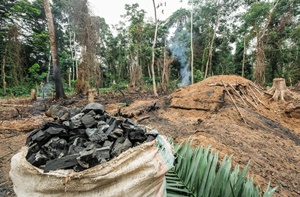
The objective of this study was to assess the charcoal yield of traditional kilns installed at Ibi Village on the Batéké Plateau, in the Democratic Republic of Congo. More specifically, the objective was to compare the yields of two Acacia species (Acacia auriculiformis and Acacia mangium), and to determine the factors influencing their performance. A total of 30 kilns were evaluated, including 15 Acacia auriculiformis and 15 Acacia mangium kilns. The results show that A. mangium kilns had a significantly higher yield (21%) than A. auriculiformis kilns (17.1%). Linear regressions (R2 = 0.96% and R2 = 0.88%, respectively for A. auriculiformis and A. mangium) identified the variables that significantly influence yields, namely, the volume of wood stacked in the kiln, the surface area of the kiln, the total mass of charcoal produced, and the reduction of losses (uncooked charcoal). These factors largely depend on the charcoal-maker's skills in setting up the kilns and monitoring the carbonization process.
Keywords: charcoal, traditional kiln, yield, carbonization, Ibi Village, Batéké Plateau