Effect of salt stress on germination and growth of five varieties of sorghum (Sorghum bicolor) in a semi-controlled environment

Abstract
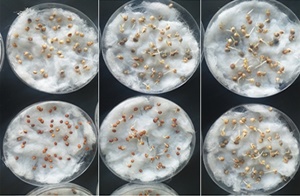
Soil salinization is a major soil degradation process that is steadily increasing in scale, with a depressive effect on crop growth and yield. The aim of this study was to investigate the effect of salt stress on germination and growth of five sorghum varieties from Senegal. The study was carried out at the Plant Physiology Laboratory of Ovidius University, Constanta (Romania). For the study of the effect on germination, seeds were germinated in Petri dishes containing increasing concentrations of salt (NaCl) ranging from 0 to 30 g/L, and for the effect of salinity on growth, sowing was carried out in plastic bags and stress was applied to sorghum seedlings at the four-leaf stage corresponding to the 15-20 th day after germination. The study showed that salt had a depressive effect on germination rate and biological growth of sorghum. However, this effect varied according to stress intensity and sorghum variety. Germination rate, height and biomass production showed that Nganda and Faourou registered varieties and the traditional variety Mbayéri mbodéri were the most tolerant to salt stress, while F2-20 and Mbayéri baléri varieties were the most sensitive to salt stress. The study also showed that sorghum physiological limit for germination was 15 g/L NaCl while that for growth was 7.5 g/L.
Keywords: Sorghum, salt stress, germination, growth, NaCl, Senegal