Salinity tolerance at the germination stage of three oasis crops in Morocco

Abstract
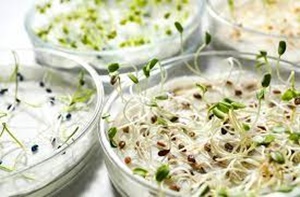
Soil and irrigation water salinity threatens plant survival. The choice of salt-tolerant species represents a solution to the constraint of salt stress. The aim of this work was the study of salinity tolerance at the germination stage of 3 crops grown in the oases of Zagora : kale (leaf cabbage), okra and alfalfa. Seeds were germinated in different concentrations of salt (NaCl) ranging from 0 to 20 g/L. The results show that leaf cabbage and alfalfa are tolerant to salinity, as their germination parameters are not significantly affected by salt concentrations up to 10 g/L. However, their germination capacity was reduced at higher salinity levels. Okra, on the other hand, tolerates salinity to a lesser degree, its germination being significantly reduced at relatively low salinity levels. Pretreatment of seeds with L-ascorbic acid (C6H8O6) significantly boosted germination rates under saline conditions. The contents of proline and total soluble sugar of seeds of the 3 species germinated under saline conditions were significantly higher than those of control seeds watered with distilled water.
Keywords: Kale, okra, alfalfa, germination, salinity, ascorbic acid