Effects of climate change on the rate of parthenocarpy of date palm (Phœnix dactylifera L.): Case of the cultivar Assiane in the oasis of Figuig
Abstract
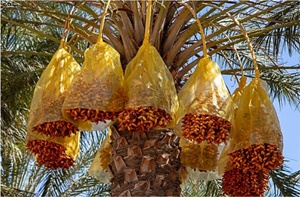
Despite the mastery of the pollination operation by Figuigui date palm farmers, parthenocarpy has led, since 2015, to an alarming drop in date production of the Assiane cultivar, which represents more than 51% of the oasis' plants. The present research aims to verify the hypothesis of the existence of causal links between parthenocarpy in date palms and the climatic changes in the Figuig oasis. To achieve this objective, we conducted a study on the effect of bagging the inflorescences of cultivar Assiane after their pollination, with three types of polyethylene veils (P17g/m², P30g/m² and P60g/m²), on the rate of fruit set and parthenocarpy. The analysis of the results showed, first, that the pollination and fruit setting phases are very vulnerable to temperature. Indeed, the low temperatures during the three flowering stages made fruiting difficult. Furthermore, the bagging of the inflorescences allowed to create favorable conditions for the germination of pollen grains thanks to the favorable temperatures that were recorded at the end-flowering stage. Clearly, the P17, P30 and P60 veils allowed higher fruit set rates than the control of 21.8, 23.4 and 30.4% and an improvement in date production of 70.3, 137.8 and 159.4% respectively.
Keywords: Oasis of Figuig, Cultivar Assiane, Climate change, Parthenocarpy, Fruit set, low temperature, Polyethylene sails
Downloads
Downloads
Published
Issue
Section
License

Revue Marocaine des Sciences Agronomiques et Vétérinaires est mis à disposition selon les termes de la licence Creative Commons Attribution - Pas d’Utilisation Commerciale - Partage dans les Mêmes Conditions 4.0 International.
Fondé(e) sur une œuvre à www.agrimaroc.org.
Les autorisations au-delà du champ de cette licence peuvent être obtenues à www.agrimaroc.org.