Effect of nitrogenous fertilizers on wheat and barley yield under biotic stress due to dry crown rot induced by Fusarium culmorum
Abstract
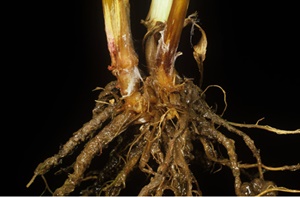
The aim of this study was to evaluate the efficiency of three nitrogenous fertilizers applied using wheat and barley grain yield achieved under biotic stress due to crown rot of cereals induced by Fusarium culmorum. The experiment took place in three greenhouses representing different environments, and using a single variety of durum wheat, bread wheat and barley. The effects of inoculation, forms and doses of nitrogen on disease severity, yield and its components were used to reach this aim. Results pointed out that yield of each variety varied according to environments, rates and forms of nitrogen used. Under conditions favorable to disease development, a 24 g L-1 of fertilizers and especially that of urea significantly reduced the yield of durum wheat by 76%. But generally, ammonitrate at a dose of 1.5 g L-1 reduced disease severity and allowed a gain in grain yield, within all environments, to reach 222%, 307% and 667% for of durum wheat, bread wheat and barley, respectively. In conclusion, the efficiency of nitrogen fertilization depended on the form of nitrogen, its rate and the environments where they were used.
Keywords: Nitrogenous fertilizers, nitrogen dose, yield performance, crown rot, cereals
Downloads
Downloads
Published
Issue
Section
License

Revue Marocaine des Sciences Agronomiques et Vétérinaires est mis à disposition selon les termes de la licence Creative Commons Attribution - Pas d’Utilisation Commerciale - Partage dans les Mêmes Conditions 4.0 International.
Fondé(e) sur une œuvre à www.agrimaroc.org.
Les autorisations au-delà du champ de cette licence peuvent être obtenues à www.agrimaroc.org.