Impact of land use change on water erosion and hydrological response characteristics of soils: Case of the Tleta catchment in north-west Morocco
Authors
H. ZAHER, M. ZOUHRI, H. BENJELLOUN, M. CHIKHAOUI, M. NAIMI, M. SABIR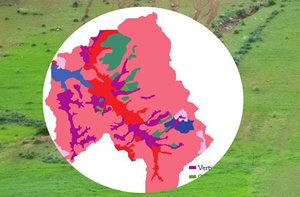
Key Information
Journal
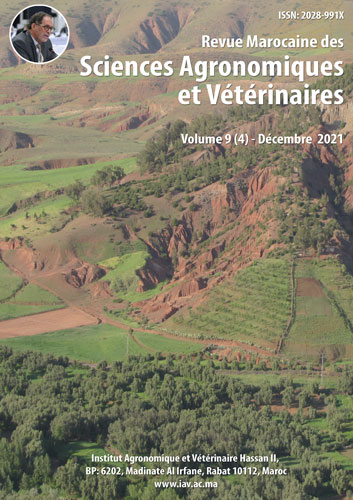
Published in Vol. 9 No. 4 (2021) of Moroccan Journal of Agricultural and Veterinary Sciences.
Multidisciplinary journal that publishes original research articles and literature reviews in the fields of agriculture, agronomy, rural engineering, topography, forestry, horticulture, food, nutrition, animal husbandry and veterinary science (online-ISSN: 2550-4401, print-ISSN: 2028-991X). Indexed by DOAJ, Google Scholar, Articles DOAJ, Mirabelle, ROAD, WorldCat
About the Journal
Abstract
This study was conducted to investigate the effect of land use on runoff and soil loss in relation with soil properties. Three types of land use were studied under simulated rainfall: matorral, fallow protected by the setting in defense and cereal farming. The results showed that fallow soils are the wettest, richest in organic matter (OM) and the most stable, followed by soils under crops and then matorrals. The analysis of the hydrological properties clearly puts the negative influence of the matorrals and the cultivation on the hydrological behavior of the soils. Matorral soils have the lowest water absorption capacity (infiltrability= 29.48 mm h-1), the highest runoff coefficient (kr = 53.12%) and the highest loss of its particles by detachability (153.45 g /m² /h). This loss of soil by detachability is equivalent on average to almost 10 times the amount recorded under fallow (14.36 g/m² /h) and 3.5 times that obtained on agricultural land (42.86 g/m² /h). It is noted that the rainfall imbibition is higher under fallow (36.61 mm) than under agricultural soils (11.97 mm) and matorrals (1.08 mm). Correlation analysis shows that the hydrologic behavior of soil in the Tleta watershed is governed by its surface condition and richness in OM. Soil infiltrability and rainfall imbibition were highly positively correlated with soil cover (r =0.93, r =0.75), soil OM (r =0.90, r =0.99) and soil aggregate stability (r =0.82, r =0.99) respectively. On the other hand, runoff generated and soil detachability due to precipitation are negatively related to the vegetation cover area (r = -0.92; r=-0.88) and the soil OM (r =-0.83; r=-0.87).
Keywords: land use, erosion, rainfall simulation, organic matter, surface condition
References
Details
License

Revue Marocaine des Sciences Agronomiques et Vétérinaires est mis à disposition selon les termes de la licence Creative Commons Attribution - Pas d’Utilisation Commerciale - Partage dans les Mêmes Conditions 4.0 International.
Fondé(e) sur une œuvre à www.agrimaroc.org.
Les autorisations au-delà du champ de cette licence peuvent être obtenues à www.agrimaroc.org.