Sediments yield appraisal by SWAT model in the Nakhla watershed, Morocco
Authors
R. BOUKHARI TALEB, M. NAIMI, M. CHIKHAOUI, M. SABIR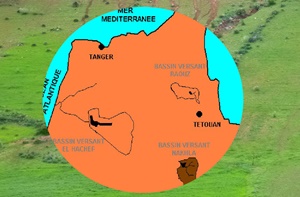
Key Information
Journal
Published in Vol. 9 No. 4 (2021) of Moroccan Journal of Agricultural and Veterinary Sciences.
Multidisciplinary journal that publishes original research articles and literature reviews in the fields of agriculture, agronomy, rural engineering, topography, forestry, horticulture, food, nutrition, animal husbandry and veterinary science (online-ISSN: 2550-4401, print-ISSN: 2028-991X). Indexed by DOAJ, Google Scholar, Articles DOAJ, Mirabelle, ROAD, WorldCat
About the Journal
Abstract
In this study, the SWAT model is implemented using a three-step calibration procedure, in order to simulate the hydrological functioning and the soil losses in the Nakhla watershed. Firstly, a pre-calibration stage that allows minimizing input uncertainty and offsetting the water balance through the duplication of the very distinct altitudinal gradient in this watershed. Secondly, an analysis of sensitivity that combines the Latin Hypercube-One Factor At a Time (LH-OAT) method and SWAT_CUP tool. Thirdly, a calibration of water flow at Nakhla and Timezouk outlets, followed by a simultaneous calibration of water flow and sediments at the Timezouk outlet. The results showed that SWAT model is sensitive to eight parameters that control the watershed's hydrological functioning and barely three parameters determining the sediment production process. The statistical and graphical criteria used to evaluate the performance of the model yielded good results at daily time step for the calibration (NS and R2>0.7) and the validation period (NS and R2?0.7). The calibration process of sediment modeling resulted in good performance at daily time step for both the calibration and validation period (NS and R2>0.5). Indeed the average soil losses at the watershed level was about 11.25 t.ha-1.year-1 for 1984-1988 period and 13.36 t.ha-1.year-1 for 1989-1993 period.
Key words: Calibration, Validation, Sensitivity analysis, Nakhla watershed, Morocco
References
Details
License

Revue Marocaine des Sciences Agronomiques et Vétérinaires est mis à disposition selon les termes de la licence Creative Commons Attribution - Pas d’Utilisation Commerciale - Partage dans les Mêmes Conditions 4.0 International.
Fondé(e) sur une œuvre à www.agrimaroc.org.
Les autorisations au-delà du champ de cette licence peuvent être obtenues à www.agrimaroc.org.