Effects of grazing on vegetation cover and soil quality in rangelands of arid regions
Authors
M. SABIR, M. QARRO, M. NAIMI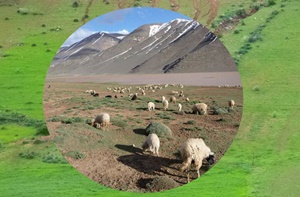
Key Information
Journal
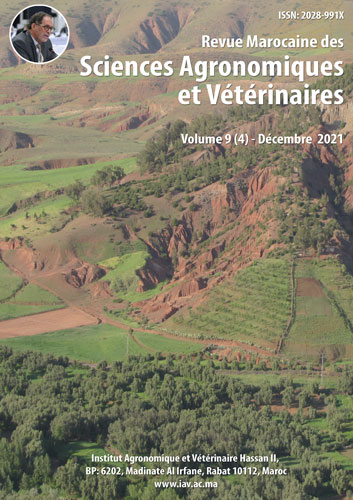
Published in Vol. 9 No. 4 (2021) of Moroccan Journal of Agricultural and Veterinary Sciences.
Multidisciplinary journal that publishes original research articles and literature reviews in the fields of agriculture, agronomy, rural engineering, topography, forestry, horticulture, food, nutrition, animal husbandry and veterinary science (online-ISSN: 2550-4401, print-ISSN: 2028-991X). Indexed by DOAJ, Google Scholar, Articles DOAJ, Mirabelle, ROAD, WorldCat
About the Journal
Abstract
Rangelands constitute a significant component of the production systems. Their use raises several questions regarding their durability. Indeed, the stocking density impacts their ecological functioning. This paper reviews the impacts of grazing on vegetation cover and soil quality of rangelands in arid and semi-arid regions. The impacts of grazing on vegetation cover, surface soil characteristics and hydrodynamic properties of soils depend on the one hand, on ecosystem characteristics (soil, vegetation, climate), and on the other hand on grazing intensity and frequency. In particular grazing reduces soil vegetation cover and impacts its structure, composition and extent. With time, the quality of vegetation cover regresses and its fodder productivity decreases. In humid pastoral ecosystems, grazing packs soil surface because of the high stocking density. This soil packing associated with a reduction of vegetation cover implies a reduction of soil infiltration capacity and an increase of runoff and erosion. On the other hand, in arid regions, the effects of grazing on soil characteristics are variable. Some studies showed that the soil is packed when the stocking density is high. Others pointed out that animal trampling does not impact soil packing. Observed differences are mainly due to soil type, moisture and the nature of grazing. Limited or moderate grazing, characterized by appropriate movement of animals makes allow for sustainable use of rangelands.
Keywords: Rangelands, Grazing, Vegetation cover; Soil characteristics; Hydrological behavior of soils
References
Details
License

Revue Marocaine des Sciences Agronomiques et Vétérinaires est mis à disposition selon les termes de la licence Creative Commons Attribution - Pas d’Utilisation Commerciale - Partage dans les Mêmes Conditions 4.0 International.
Fondé(e) sur une œuvre à www.agrimaroc.org.
Les autorisations au-delà du champ de cette licence peuvent être obtenues à www.agrimaroc.org.