Semi-quantitative scoring system for the evaluation of microscopic lesions in the trachea of turkeys following experimental infection with LPAI H9N2
Authors
Yassmina BIDOUDAN, Saadia NASSIK, Oufae FASSI FIHRI, Enrico BOLLO, Mohammed EL HOUADFI, Noursaid TLIGUI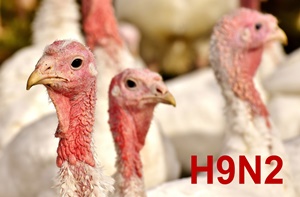
Key Information
Journal
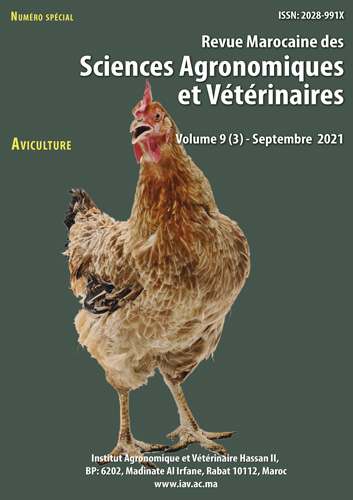
Published in Vol. 9 No. 3 (2021) of Moroccan Journal of Agricultural and Veterinary Sciences.
Multidisciplinary journal that publishes original research articles and literature reviews in the fields of agriculture, agronomy, rural engineering, topography, forestry, horticulture, food, nutrition, animal husbandry and veterinary science (online-ISSN: 2550-4401, print-ISSN: 2028-991X). Indexed by DOAJ, Google Scholar, Articles DOAJ, Mirabelle, ROAD, WorldCat
About the Journal
Abstract
The present study has been designed to contribute both in the evaluation of the pathogenicity of the Moroccan strain of low pathogenic avian influenza virus (LPAI) H9N2 in turkeys and vaccine efficacy against it. For this purpose, clinical monitoring and examination of gross and hitopathological lesions following vaccination at 8 days and a challenge at 26 days of age were carried out. The study was conducted on 80 turkeys, which were divided into 4 groups (A: vaccinated and challenged, B: vaccinated and unchallenged, C: unvaccinated and challenged, and D: unvaccinated and unchallenged). Birds were observed daily for 15 days after the challenge for clinical signs. 10 poults from each group were euthanized and autopsied 5 days post-challenge (DPC) and at 10 DPC. Gross lesions were evaluated during necropsy, and trachea samples were collected, and placed in a 10% neutral buffered formalin solution for histopathological examination. All challenged birds exhibited respiratory signs during the observation period which consisted of rales, coughing, sinusitis and ocular and nasal discharges, with lethargy and ruffled feathers. Mortalities of 20 % and 50 % starting 7 DPC were recorded in group A and B respectively. Necropsy revealed fibrinous sinusitis, tracheitis, and fibrinous aerosacculitis in groups A and B with pneumonia only in group B at 5 DPC. Histopathology of the trachea in all the infected birds revealed a lympho-plasmocytic tracheitis with mononuclear cell infiltrates, hyperplasia of epithelial cells, metaplasia, and loss of cilia and mucous glands. Lesions exhibited a varying range of severity depending on days post challenge and groups. Thus a scoring system of 4 grades was created to evaluate and compare groups. Score 0 corresponds to normal tracheal structure, histologic scores of 1 and 2 are characterized mainly by congested blood vessels, depletion of specialized cells, and mononuclear infiltrates, while score 3 corresponds to a histologic pattern of notable thickening of mucosal lining by hyperplasia of epithelial cells, severely congested blood vessels, and metaplasia of surface epithelial cells. Lesions were significantly more severe at 5 DPC, and a visual but non-statistical difference between groups at the same necropsy was noted. The scoring system showed consistent results and helped broaden the perspectives of the present study, and proved to be a reliable tool in the setting of experimental studies in avian pathology.
Keywords: Histopathologic lesions, scoring system, Turkey, H9N2, experimental infection
References
Details
License

Revue Marocaine des Sciences Agronomiques et Vétérinaires est mis à disposition selon les termes de la licence Creative Commons Attribution - Pas d’Utilisation Commerciale - Partage dans les Mêmes Conditions 4.0 International.
Fondé(e) sur une œuvre à www.agrimaroc.org.
Les autorisations au-delà du champ de cette licence peuvent être obtenues à www.agrimaroc.org.