Drinking water quality for poultry farming in Morocco: Bibliographic update
Authors
Abdelaziz EL HRAIKI, Abdellatif MAROUANE, Mustapha AKCHOUR, Tarik ABDELMOUTALEB, Driss BENGOUMI, Imane TAHA, Mohammed BENGOUMI
Key Information
Journal
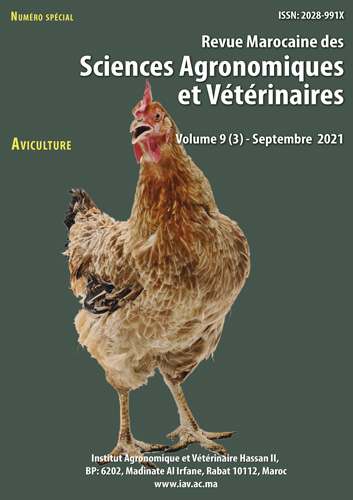
Published in Vol. 9 No. 3 (2021) of Moroccan Journal of Agricultural and Veterinary Sciences.
Multidisciplinary journal that publishes original research articles and literature reviews in the fields of agriculture, agronomy, rural engineering, topography, forestry, horticulture, food, nutrition, animal husbandry and veterinary science (online-ISSN: 2550-4401, print-ISSN: 2028-991X). Indexed by DOAJ, Google Scholar, Articles DOAJ, Mirabelle, ROAD, WorldCat
About the Journal
Abstract
The purpose of this synthesis is to compile and analyze data on the monitoring of the quality of drinking water in poultry farms in most regions with a poultry breeding vocation (Zone 1: North, Zone 2: South; Zone 3: Center) carried out over several years (2000 -2015). A total of 205 poultry farms were monitored for the physico-chemical quality of the water (Zone 1 and 2) and 172 farms were subjected to analysis of the bacteriological quality of their drinking water. The farms that have undergone quality control for drinking water were selected to ensure regional representativeness but for ease of access to the area of ??health veterinarians supervising these farms. The physico-chemical water quality was based on the determination of the pH, hardness (TH), electrical conductivity (EC), nitrates, iron, sodium and chlorides. The bacteriological quality concerned the evaluation of the total contamination by the enumeration of the total aerobic mesophilic flora (FMAT), the appreciation of the contamination of fecal origin by the enumeration of total coliforms (CT), fecal coliforms (CT) and fecal streptococci (SF) as well as the enumeration of Anaerobic sulfite-reducing Clostridium (ASR). The physico-chemical water quality was based on the determination of the pH, hardness (TH), electrical conductivity (EC), nitrates, iron, sodium and chlorides. The results of the physico-chemical parameters, from the northern regions of Morocco (Zone 1) show that the water is of fairly good quality except in terms of hardness where three out of five regions have values ??greater than 50 ° f (acceptable limit). Likewise, sodium and chloride contents are very high and exceed acceptable limits, especially in the regions of Casablanca, Rabat and Tetouan. For the southern regions (Zone 3), the water has a satisfactory quality from the point of view of nitrate contents (8.0 ± mg / l) and pH (7.30 ± 0.23) while the hardness greatly exceeds the 50 ° f limit for all regions with an average of 70 ± 28 ° f. The sodium (505 ± 412 mg / l) and chloride (832 ± 731) contents are very high, especially for the EI Kalaa and Tiznit regions. The results of the bacteriological parameters show a variation in the quality of the water depending on the regions and the microflora. In zone 1, the bacteriological quality is satisfactory for 65.5% of the samples complying with the standards recommended for the FMAT, 56.4% for the CF, 43.6% for the SF, 80% for the CT and 83.6% for ASRs. In zone 3 (middle Atlas and Gharb), the bacteriological quality is rather poor with average FMAT contents of 995 UFC / ml with a maximum value of 4800 UFC / ml. This pollution is also manifested by high levels of CFs, CTs, SFs and ASRs that greatly exceed the quality standards for drinking water for poultry use.
Key words: poultry farms, bacteriological quality, physical and chemical quality, Pollution, water
References
Details
License

Revue Marocaine des Sciences Agronomiques et Vétérinaires est mis à disposition selon les termes de la licence Creative Commons Attribution - Pas d’Utilisation Commerciale - Partage dans les Mêmes Conditions 4.0 International.
Fondé(e) sur une œuvre à www.agrimaroc.org.
Les autorisations au-delà du champ de cette licence peuvent être obtenues à www.agrimaroc.org.